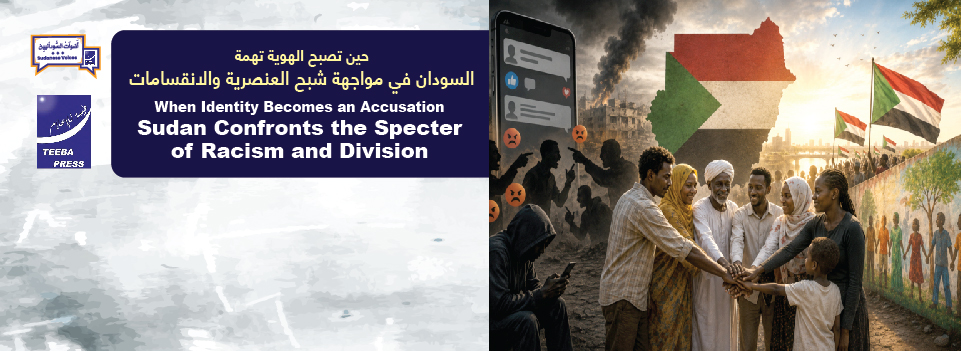
When Identity Becomes an Accusation: Sudan Confronts the Specter of Racism and Division
Sudanese voices
Mon /June/1st
J٠SH
In times of war and major crises, nations are tested not only by their ability to manage conflict, but also by their commitment to the values of justice, citizenship, and coexistence. Yet the alarming rise of hate speech, racism, and incitement based on ethnicity, tribe, or regional identity in Sudan today raises profound questions about the country's future and the unity of its social fabric.
Within the devastation brought by war, narratives rooted in classification and exclusion have increasingly emerged, fueling suspicion and hostility toward certain groups. These narratives are no longer confined to social media platforms or political debates; they have become part of the broader public discourse, posing a serious threat to social cohesion and peaceful coexistence among Sudanese communities.
One of the most controversial phenomena is the pursuit of so-called "strange faces" a label that carries deeply troubling implications. It shifts suspicion away from actions and behavior and places it on identity and belonging. When a person's appearance, accent, or place of origin becomes grounds for suspicion, society begins to drift away from the rule of law and toward a culture of exclusion.
The danger of this trend becomes even more apparent when it coincides with tragic incidents that spark public outrage and deepen fears of growing discrimination and hatred. Among these incidents is the widely discussed case involving the deaths of *Khalid Faisal* and *Mohammed Bakhit* , members of the HABBANIA TRIBE. The incident generated significant public reaction and raised difficult questions about the broader environment in which issues of identity and belonging are increasingly being contested in Sudan.
Regardless of the legal circumstances surrounding any particular case or the outcome of investigations, the deeper concern lies in the growing perception among many citizens that tribal or regional identity may influence how they are viewed or treated. Such perceptions alone are capable of creating a profound rupture in trust both between citizens and the state and among communities themselves.
History has repeatedly shown that hate speech does not begin with violence; it begins with words. It starts by dividing people into "us" and "them," then evolves into the justification of exclusion and discrimination before ultimately paving the way for more serious abuses that threaten peace and stability. Confronting racism, therefore, is not merely a moral imperative; it is a national necessity for safeguarding Sudan's unity and future.
Sudan is a country rich in ethnic, cultural, and tribal diversity. This diversity is not a burden to be eliminated but a national asset to be protected. Any attempt to reduce citizens to narrow identities or to judge them based on their origins rather than their legal rights represents a direct threat to the very concept of the state.
Addressing security challenges cannot be achieved through collective suspicion, prejudice, or campaigns of classification. It requires independent institutions that uphold the law equally for all citizens without discrimination. The rule of law remains the only guarantee of security and the strongest safeguard against both chaos and injustice.
Today, more than ever, Sudan needs a unifying national discourse that rejects racism and hate and reaffirms the principles of equal citizenship. Nations are not built through exclusion, nor is stability achieved by dividing citizens into competing groups. They are built through justice, equality, and respect for human dignity.
The real struggle facing Sudan is not between tribes, regions, or ethnic groups. It is a struggle between two competing visions: one that seeks to build a state founded on law and equal citizenship, and another fueled by hatred and division. Between these two paths lies Sudan's future either a homeland that belongs to all its people, or a landscape consumed by endless conflict.