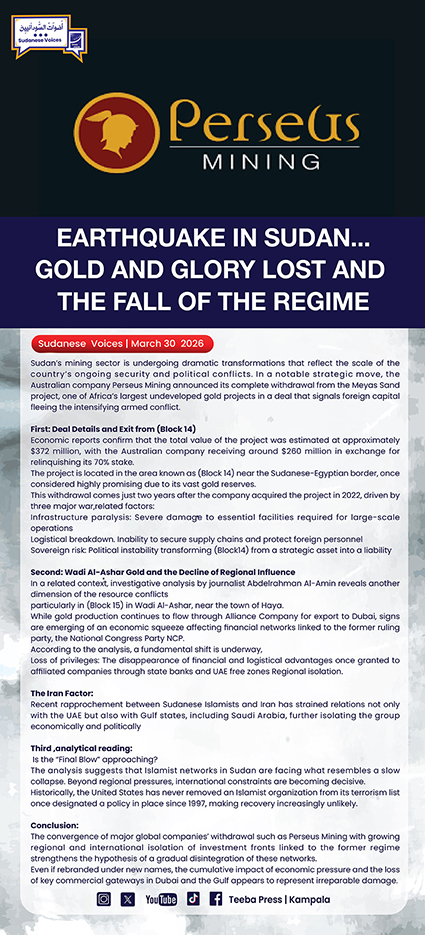
زلزال في قطاع التعدين السوداني.. انسحاب بيرسيوس وتآكل الإمبراطورية المالية للنظام السابق
EARTHQUAKE IN SUDAN...GOLD AND GLORY LOST AND THE FALL OF THE REGIME ”
Sudanese voices
Mon/30/March
Sudan’s mining sector is undergoing dramatic transformations that reflect the scale of the country’s ongoing security and political conflicts. In a notable strategic move, the Australian company Perseus Mining announced its complete withdrawal from the Meyas Sand project, one of Africa’s largest undeveloped gold projects in a deal that signals foreign capital fleeing the intensifying armed conflict.
First: Deal Details and Exit from (Block 14)
Economic reports confirm that the total value of the project was estimated at approximately $372 million, with the Australian company receiving around $260 million in exchange for relinquishing its 70% stake.
The project is located in the area known as (Block 14) near the Sudanese-Egyptian border, once considered highly promising due to its vast gold reserves.
This withdrawal comes just two years after the company acquired the project in 2022, driven by three major war,related factors:
Infrastructure paralysis: Severe damage to essential facilities required for large-scale operations
Logistical breakdown. Inability to secure supply chains and protect foreign personnel
Sovereign risk: Political instability transforming (Block14) from a strategic asset into a liability
Second: Wadi Al-Ashar Gold and the Decline of Regional Influence
In a related context, investigative analysis by journalist Abdelrahman Al-Amin reveals another dimension of the resource conflicts
particularly in (Block 15) in Wadi Al-Ashar, near the town of Haya.
While gold production continues to flow through Alliance Company for export to Dubai, signs are emerging of an economic squeeze affecting financial networks linked to the former ruling party, the National Congress Party NCP.
According to the analysis, a fundamental shift is underway,
Loss of privileges: The disappearance of financial and logistical advantages once granted to affiliated companies through state banks and UAE free zones
Regional isolation.
The Iran Factor:
Recent rapprochement between Sudanese Islamists and Iran has strained relations not only with the UAE but also with Gulf states, including Saudi Arabia, further isolating the group economically and politically
Third ,analytical reading:
Is the “Final Blow” approaching?
The analysis suggests that Islamist networks in Sudan are facing what resembles a slow collapse. Beyond regional pressures, international constraints are becoming decisive.
Historically, the United States has never removed an Islamist organization from its terrorism list
once designated a policy in place since 1997, making recovery increasingly unlikely.
Conclusion:
The convergence of major global companies’ withdrawal such as Perseus Mining with growing regional and international isolation of investment fronts linked to the former regime strengthens the hypothesis of a gradual disintegration of these networks.
Even if rebranded under new names, the cumulative impact of economic pressure and the loss of key commercial gateways in Dubai and the Gulf appears to represent irreparable damage.